
The most damning appraisal of a new production I ever heard was about Billy Budd in Munich, of which someone said “It looked like an opera”. What was the catty critic saying? I took it to mean the production was like a parody of all the clichés to be found on the opera stage. A bare set with austere lighting, the pistol MacGuffin, quirky under-rehearsed choreography, characters standing on chairs for moments of heightened emotion and sitting on the floor for “down” scenes are the trope traps into which directors lacking a feel for how to bring opera to life often fall. Last night’s Bernstein double bill of Trouble in Tahiti and A Quiet Place in the Linbury, while a bold and laudable production of two difficult pieces, had ‘em all.
Ollie Mears, the director, encouraged the performers to be lured into the music’s mood to inform their every movement. Bernstein’s swinging rhythms became the underpinnings of cushion-throwing dance numbers. It reminded me of the wriggle classical pianists do when they’re playing funky music that tells us they’re outside their comfort zone and haven’t danced since their first school disco.
Attached to this blog you’ll see a post of Gershwin playing I Got Rhythm as an encore at a concert in the Manhattan Theater in 1931. You’ll notice, if you turn the sound down, that you could be forgiven for thinking he’s playing Beethoven, so still and technical is his playing. For Gershwin, and by extension for Bernstein, his music isn’t written to be light; it’s as serious as any music you find on the concert platform and is to be spoken as American poetry with an American accent. But we non-Americans hear jazz, jive and jauntiness in its synchopations and immediately think it’s dance music. It isn’t, it’s C20th American musical vernacular. Ravel understood this when he met Gershwin in 1928 and asked him, “Why would you want to be a second rate Ravel when you can be a first rate Gershwin?”
I’m not a critic and I don’t write reviews but, after thirty years of treading the boards, I do have opinions on what works and doesn’t work on the opera stage. I wrote in a previous blog (Hit Rate) about the need for more consistency in the quality of new productions on the opera stage, both here in the UK and elsewhere. Opera bosses have got used to rolling the dice with hundreds of thousands of pounds at stake and hoping for a hit that audiences will want to see again in a revival but they are not challenging their directors to produce watertight work. In short, they tolerate too much risk.
Repeating my thoughts from previous posts, the easiest way to mitigate the risk is to do more work in the studio. Repetition releases singers from the shackles of producing work that “looks like an opera”. Repetition to the point where singers get bored and start complaining gets the physicality deeper into their bodies. They start to line up their movement with their breathing and singing which makes their portrayals organic and natural. It’s when this happens that opera transcends being drama set to music and becomes so much more than the sum of its parts.
I observed the same symptoms of under-rehearsed work in the new production of Eugene Onegin last week on the main stage at RBO. Some of the cast were slick and believable but some crucial characters were stiff and unconvincing. I’ve worked with broadway directors in my time. They conduct rehearsals with an energy that never drops. “From the top” is the cry you hear the very second notes and adjustments have been dispersed around the studio by assistants. For them, repetition ad infinitum is the key to making their work look wrought and convincing.
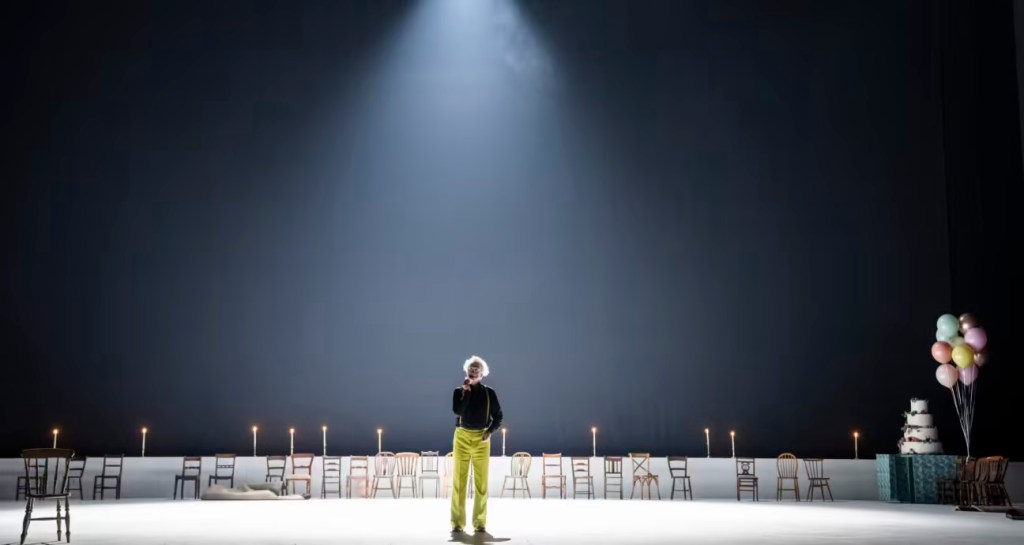
Another observation I make of new productions is the ubiquitousness of open sided and empty sets. The cavernous stage of Onegin made it hard for singers to project if they stepped behind the curtain line. Singers are the last people to find out what a new production will look like. Too often, on first days of rehearsal, I’ve seen looks exchanged between colleagues as set designs are revealed. The look says, “Here we go. Another unhelpful set.”
There are ways to produce work that’s looks fresh, modern and even challenging without sacrificing priorities like audibility and credibility. Modular trucks, like those in RBO’s brilliant current production of La Boheme that are wheeled into the space between scenes, enable the audience’s attention to be focused with lighting while providing singers with a resonating back wall that acts as a springboard for their voices.
The Onegin was a missed opportunity for creating another cash cow production that comes back regularly at little cost above the contracts of a fresh cast and set storage. For years, the RBO has relied on a handful of solid productions to balance the books – Richard Eyre’s La Traviata, Jonathan Kent’s Tosca and David MacVicar’s Magic Flute among them. The new Onegin should have been another but its lacklustre first run-out will mean the marketing department will doubt its revivability and it will become a rarity in the RBO’s planning until they get a better production in ten years time – a shame because Tchaikovsky’s masterpiece is a ravishing portrayal of how, in G.B. Shaw’s words, “Youth is wasted on the young.”
 Toby the Tenor
Leave a comment