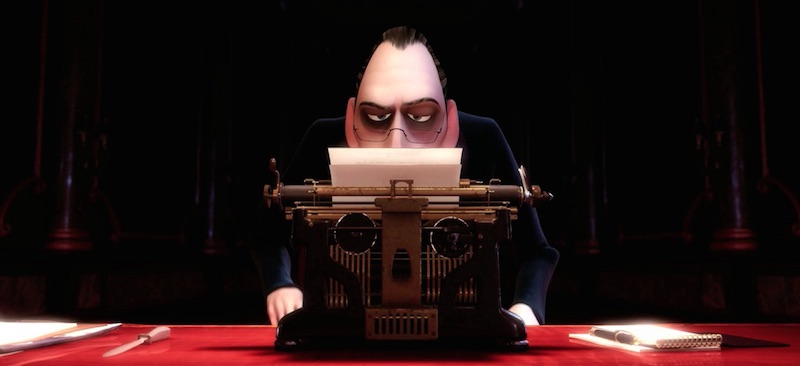
I wish more people could see the view from a set in an opera rehearsal room. The set tends to be squeezed into a large room, taking up 95% of the space. Lined along the remaining strip in front of the set are the piano, the language coach, a member of music staff, the conductor, the director, the director’s assistant, a staff director, the stage manager and the props manager all seated behind behind desks. Each looks onto the set with a mixture of fixed attention, sleepy boredom and everything in between.
Often, especially in UK opera houses, there is a container of baked goods or Haribo at one end of the row of desks, towards which hands are extended, treats withdrawn and then inserted into mouths. We on stage work on as if this constantly tantalising distraction isn’t happening.
Above coping with long periods spent away from home, the stress of performance and the constant pressure to be on top of preparation, perhaps the hardest lesson to learn for any performer is how to take criticism. Even before stepping on stage, performers are appraised with notes in coaching sessions, studio rehearsals and in music calls. Sometimes there are three sets of notes to be received and absorbed in one rehearsal – music notes, staging notes and language notes, all from different quarters.
When I’m fresh and confident, I receive the notes gratefully, knowing the intention of the person giving them to me is to make me a better performer. At the end of a day towards the end of the week, when I am tired and doubting myself, I can forget to receive the criticism as gratefully as I should. My insecurity can get the better of me and I can be over-sensitive to imagined subtext within the notes. “You do it then,” I hear my inner voice say as someone gives me a note I’d prefer not to receive.
I’m a very poor multi-tasker and if my focus is on one aspect of my preparation at any one time, the rest of it can fall apart. Caught at the wrong moment, I can be monosyllabic and curt as I take someone’s observation on board.
Over the years I have developed methods for taking in lots of information in a given moment. I mark staging with small Post-It notes in my score because a stage director can change their mind about what’s called the blocking or the movement on stage. Musical notes I mark in pencil in the score, while language notes are marked in my own made-up phonetic alphabet.
When the running of a section stops, conductors give musical notes from their podium while directors tend to walk onto the set to converse about the story telling. Last and always tentatively, the language coach approaches with their score to point out a linguistic slip. At 4pm on a Friday, the poor language coach draws the short straw and can be lashed unfairly with “Not now, please. Can you write it down for me?”
The best of the true pros among singers are always, without fail, courteous and receptive to the notes they are given, even if they turn upstage to their colleagues and roll their eyes as the note-giver retreats to their chair. I have to remind myself that it is for my good that they give me the notes and that I have to be grateful. I’m not as infallible as some of my colleagues.
And then there is criticism of the printed kind. Having worked for weeks in the studio and then on stage to present the production, we have our opening night. In theatre, actors have a week’s grace, sometimes more, to perform their play to a paying audience in previews before critics are allowed to review it. In opera there is no such safety net. We have our dress rehearsal and then, a few days later, we open to critics and audience for the first time. The reason for the lack of run-out in opera is two-fold: operas run for no more than eight performances over short periods so the sooner reviews can be released the better for publicity reasons, the other reason is the high cost of opera that makes performing to empty seats unviable.
Up until 2012, I used to run out to buy newspapers to read reviews, be they good or bad. I was eager to read what the critics thought of me and the work of my collective team. Sometimes the reviews were good and sometimes middling. The truth is that, no matter how good the reviews were, I would always read bad things into them. “The tenor had a compact voice…” A COMPACT VOICE? What does that mean? I’d make myself miserable by ruminating on the inner meaning of every word.
In 2012, I was diagnosed with cancer and lost my voice following surgery, as some readers will know. The journey to find my voice again was long and difficult. Many would say I started to perform in public too soon but I was advised that the only way to find my voice again was to get back on stage. For a long time I was over-exposed and underperforming. It was a very difficult time of my life and I find it hard to reflect on those years even now. To survive I stopped reading reviews. It would have been too painful even to read the kind ones. Until today, I have no idea what was written about me at that time. To believe good reviews, it follows that one has to put stock by the bad ones and to read the bad ones is an act of self harm, so I avoid both.
The way opera is reviewed has changed in the past decade. It used to be the case that the most knowledgeable critics worked for daily and Sunday newspapers. These days, many papers have laid off their music critics and coverage has been siloed to specialist websites and periodicals. To find reviews one has to go looking for them. They have become avoidable now that the greater part of publicity has transferred to social media like Instagram and TikTok and is less reliant on critics.
And so it is, by way of choice and shifting trends in the way performances of music and opera are covered in the press, that I am barely ever confronted by criticism of my own performances.
I mourn the demise of music criticism because we have a long and celebrated history of it in the UK. G. B. Shaw made his bread and butter covering the music scene of London in The Star and later The world under the pen name Corno di Bassetto. The London based monthly magazine Opera is still the most comprehensive collection of reviews from theatres around the world in existence. Its late editor, Rodney Milnes, had an encyclopaedic knowledge of operatic history and edited the four volume Grove History of Opera. Today, I would trust the opinion of the UK’s best critics over the opinion of any other European critic but for how much longer will the noble profession of music criticism exist without the support of mainstream print media?
 Toby the Tenor
Leave a comment