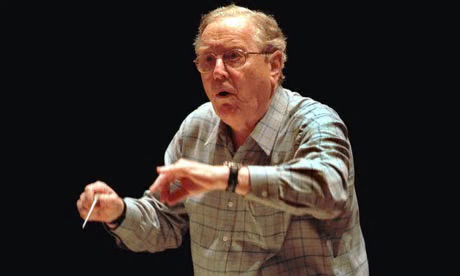
Next year will be the centenary of Charles Mackerras’s birth. In anticipation, I’ve decided to write about my memories of working with him. In preparation, I’ve read some of the interviews he gave and had a look at his obituaries, of which there are many. None of them goes to any length to describe what it was like to work with him because the people who write about him tend not to be practitioners of music. I want to put that right by remembering the fifteen years I spent working with him. I had the privilege to work with him on works by Handel, Mozart, Beethoven and Janacek (among others) of which his authority was unequalled.
The first time I met Sir Charles, or Charlie as we called him when he wasn’t listening, was in an audition for the role of Idamante in Mozart’s Idomeneo. Welsh National Opera were planning a revival of their successful production from 1992, directed by Howard Davies, and were casting around for a young tenor to take the important role.
Mozart rewrote the role of Idamante for a tenor after a bad experience with the castrato, Vincenzo del Prato, in the first production at Munich’s Cuvillés Theatre. These days, most theatres cast the role as a “trouser” role, to be taken by a mezzo-soprano who can affect a boyish demeanour. Sir Charles preferred Mozart’s chosen alternative, on account of its historic precedence.
My audition took place at Cecil Sharp House, near Regent’s Park, in 1994, when I was still a student at the Guildhall School. My standard audition technique at the time was to present less obvious choices of aria. On this occasion, I had prepared Idamante’s “other” aria. The role has two arias and everyone auditions the one titled “Non ho colpa” (It’s not my fault), it being the longer and more taxing of the two arias. Knowing I was up against stiff competition, I prepared the short, easy one titled “Il padre adorato” (The beloved father), thinking it would be a nice change for Sir Charles and that I could show off my strengths better than with the tricky one.
To my surprise, he sat on a chair in the middle of the large room with the full score balanced on his knees, four feet away from me. I would have preferred him to sit towards the side of the room to give me space but the room was resonant and I imagine he wanted to hear the detail inside my sound to know what was going on with my technique.
As I sang, he followed his score and occasionally looked up, wrinkling his nose to raise the lenses of his glasses as if to study me. I did my bit and then he asked why I hadn’t prepared the other aria.
“I thought everyone else would prepare that one and reckoned you’d be glad of a change.”
He chuckled, then said, “You were a choral scholar, yes?” I nodded. “Then you can sight read the other one, can’t you?” I’m not a great reader, being dyslexic.
“I’ll give it a go.” I said, hoping courage would win me some points and hiding the fact that I wouldn’t be sight reading at all; I knew the longer, tricky aria as well as I knew the easy short one.
I got the job and found myself in Cardiff a year later, almost immediately after finishing my post-grad at the Guildhall, stepping into rehearsals for my first professional opera job. I soon learnt Charlie was a stickler for precision and observance of what the composer intended.
As well as a baton, Charlie always brought a well stocked pencil case out of which he would take various coloured pencils for specific types of note taking. He would also produce little pieces of paper on which he had taken the time to write out ornaments and embellishments in between rehearsals. Collectively, we didn’t like this as a cast because memorising and remembering his notes added to the workload but he would insist on us learning and inserting them into our portrayals.
Repeating mistakes would be met with a surly impatience. He’d stop, shake his head and say with his gravelly Australian bur, “No. No. You’ve done it again.” He would then go over what he wanted with a pedantic manner that irritated me. “Again,” he’d say. I’ve always strived to exceed expectations in the rehearsal studio but I felt like I could not live up to Charlie’s high standards.
It wasn’t long before I found out why he insisted on embellishments being done his way. He had spent his life researching historical performance practice of Mozart’s time and was the first practioner to apply the research to modern performance. Other academics had researched treatises and manuscripts from Mozart’s time and had theorised about it but no-one, until Sir Charles came along, had been both researcher and practitioner.
Allow me to take a paragraph to explain the kinds of unwritten embellishments I mean. In Mozart’s time, the rules of writing music were such that, for practical reasons to do with the way music was printed, composers had to adhere to strict conventions and rules in order to avoid criticism for stepping outside what were held to be classical ideals of all things aesthetic. Mozart, in order to imbue his music with the squeeze-release of dissonance to resolution that gives music a sense of forward motion, asked his performers to add them in their performance. Such an unwritten addition could be as simple as a passing note between two notes divided by a two pitch interval. The pitch between the notes is not written because that would break the rules of the time but the performer would know to link the two notes with the note in between. The added material could also be an extended cadenza, inserted to show-off the soloist’s specific skills. Mozart asked for such additional detailing because it was like seasoning in his music. It added flavour, colour and emotion, at the same time, giving the music flow and direction. Subsequently, the singers and chroniclers of the time would write treatises on the practice so it could be replicated elsewhere. When the music of Mozart’s time fell out of fashion, the conventions for how it should be performed were lost. It wasn’t until music historians of the C20th mined libraries for clues as to how to more faithfully perform the music to Mozart’s time that the conventions came to light again.
In 1956, after being encouraged to pursue his interest in historically informed performance by, among others, the conductor and repetiteur, Maurits Sillem, Mackerras travelled to Donaueschingen with his young family in tow for a holiday, planned to be strategically close to various libraries where important historical documents were archived. He visited the Fürstliches Museum to look at the famous, incomplete manuscript full score of Mozart’s Le Nozze di Figaro that predates the first edition and contains annotated embellishments that never made it into print.
In 1995, Mackerras commented to the scholar, H C Robbins Landon, “Not only was the version of the whole score quite different from any other, but it was also full of ornamentation of the various arias.”
In 1965 at Sadler’s Wells in London, Sir Charles conducted The Marriage of Figaro, deploying for the first time in performance since the C18th the unprinted Mozartian embellishments of the Donaueshingen manuscript so vital in bringing his music to life, along with pastiche embellishments in the third and fourth acts that followed the conventions established in the known manuscript. The performance of Figaro was a departure point for historically informed performance and caused a sensation. The headline in The Times on its revival in December of that same year read “A Figaro that beats all others.”
Suddenly the music made sense because the recitatives flowed like conversation, melodies had a quality of improvisation and cadences lost their stodginess. In general, the music sounded modern, sharp, focused and all but the hardiest traditionalists were immediately convinced that this was how Mozart should be performed.
Sir Charles’s study into historical performance never ended. At the time I was working with him, when he was seventy, he had a library that included the world’s largest collection of manuscript fragments – small pieces of music manuscript on which composers and performers, including Mozart himself, had written ideas for musical embellishments, much like the small handwritten fragments Charlie handed out to his Idomeneo cast in 1995.
One might think Charlie’s attention to the detail would impede the life in the music once we started to run the work in chunks. This was the extraordinary thing: while he was a stickler and a bit of a bugger when it came to detail, when the time came to make music, he was right there for us. He would fix his attention on us, alert and listening intently, while supporting and driving us at the same time. His concern was that the music should be the best possible representation of itself and he knew what we needed in order to help him achieve his goal.
Privately, and to make my colleagues laugh at the irreverence, I’d call him the Humping Hamster on account of his fixed gaze from the conductor’s podium, hunched over his score, his tongue visibly churning inside his mouth like a scribe in deep concentration. His conducting style wasn’t the most elegant but it was crystal clear and he never made mistakes.
His sense of tempo was pinpoint accurate. There was a story from a time when he was working at the Met in New York: in a rehearsal he was seen to take an electronic metronome out of his pencil case and dial in a speed to check it with the marking in his score – “Some people call this genius” he quipped to his assistant.
If there was anything approaching genius, it was born of painstaking preparation and service to the music. Charlie wasn’t grand but he demanded respect. He knew he was special and could be intolerant of collaborators who were unable to live up to his exacting standards.
To have his influence right at the start of my professional life was a huge privilege and spurred me to look deeper into music for the clues that lead us to its truth, its universality and that “time traveller” quality I wrote about in my previous blog post titled “Time Machine”.
I will continue with my recollections of Sir Charles in my next post.
 Toby the Tenor
Leave a comment