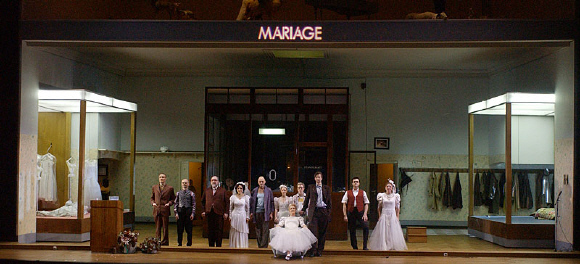
In 2000, I was part of a production of Berlioz’s Les Troyens at Salzburg Festival. My part was short but sweet, allowing me to drop in on other productions in rehearsal to watch and learn.
At that time, the festival was run by the late Belgian impresario, Gerard Mortier. I owe much to Mortier because he gave me some of my first leg-ups into a career on the opera stage. At that time, there were no apprentice programs, like the Jette Parker at Covent Garden, for young singers to learn the craft. It was a case of learn fast or don’t work in those days.
In the early days of my career, one of the first things I learnt to do was audition. I set about analysing what audition panels want to see and then planned an audition technique to raise my chance of fulfilling the criteria. I’ll write about that another time.
In 1995 I did a good audition for Gerard Mortier on the stage of La Monnaie, the opera house in Brussels where he was the intendant before taking up his role in Salzburg. My strong audition led to several contracts from La Monnaie and subsequently from Salzburg when he took up his post there.
Salzburg being the summer home of the Vienna Philharmonic Orchestra and generously funded by the Austrian government, is one of the most glamorous and luxuriously programmed festivals in the music world. Everyone who’s anyone goes at some point in their career. Under Mortier’s direction, the festival became known for state-of-the-art avant-garde productions by the eccentric creatives with whom Mortier surrounded himself – I will write another post about Mortier next week.
One of the eccentrics in Gerard’s stable was the unique stage director, Christoph Marthaler. Marthaler had been the oboist in the orchestra of the Zurich Opera and had spent a career observing the productions on the stage there. How he transitioned from pit to stage I don’t know and I never heard of anyone else making a change like it.
Working with Marthaler didn’t feel like work. A common theme among all the creatives Mortier returned to again and again was their bon-vivant attitude to life. Marthaler was no exception. His working process was open ended, meaning members of his casts were invited to lunch and dine together with him and the music staff. Food was accompanied by generous quantities of good wine and there was always laughter at the table. He had a light social touch and all the while he observed his cast members for material to incorporate into his productions.
He would sidle up to you in rehearsal and quietly say “You know that story you told last night about the time you… I want you to put that in this scene. You come up with something. Show it to me when we run the scene.” His working method was like child’s play, cherry picking our experience and weaving it into the fabric of the narrative.
That year in Salzburg Marthaler was directing The Marriage of Figaro on the smaller stage next to the one where I was rehearsing Les Troyens. I had never heard of Christoph Marthaler and had no idea of his working method but I observed his work in progress and kept going back to his rehearsals to see if any of his art could rub off on me.
Marthaler works exclusively with one designer, Anna Viebrock, whose style I would call meta-reality. Her aesthetic is Mittel Europa modernism inhabited by East German’s who had popped through the Berlin Wall at Brandenburg Gate in late 1989. Think sleek lines that were once sharp and futuristic that had fallen into disrepair with naff curtains added and eccentrics in shell suits. On top of this she has a neat ability to make interiors seamlessly morph into exteriors without needing to change the set. Her inside/outside distressed-chic visual universe creates a tangy tension on the stage and opens up a world where anything can and does happen.
For the Figaro she had devised a scenario in an alpine hotel with a sideline in weddings, servicing all nuptial requirements from wedding gowns to a room at the back of the set that served as a registry office where unknown characters came, waited and went. The Count, a Basil Fawlty character in this production, officiated some of the marriages, no doubt having his “droit de seigneur” with any bride-to-be who caught his eye.
There was neither a harpsichord nor a forte-piano in the pit to accompany the recitatives. Instead, there was a nameless character who mysteriously moved in and out of the action from his bedsit above the main acting space. He had a Yamaha electric keyboard that could approximate the sound of instruments and effects. Sacrilege! A Yamaha in Mozart? In Salzburg?? With the Vienna Philharmonic??? For purists, the thought of it could herald the end of the world.
The story goes that Marthaler had stayed at a mountain refuge where there had been a resident keyboard player who played strangely inappropriate music at odds with the beautiful landscape outside. Marthaler, being the eclectic eccentric that he is, asked the keyboard player for his details and waited for the opportunity to employ him for one of his productions.
And so it was that Jürg Keinberger found his way from hotel keyboard player to Salzburg Festival in one unlikely leap. His presence on the set was probably a simulacrum of that in the hotel of Marthaler’s mountain holiday. He would add little musical numbers to the score, sometimes he would accompany the recitatives with sound effects from his keyboard. In one recit, he and the Cherubino had beer bottles out of which they would drink to change the pitch when they blew across the opening to provide the accompaniment. Jürg would yodel ditties in between scenes.
The count danced the tango in one of his arias, characters appeared from inside coats hanging on a peg, Barbarina went looking for her pin in the wedding dress shop window. The conductor occasionally took photographs of the goings-on on stage with a Box Brownie. I would watch open mouthed at the freedom and inspiration. It shattered my firmly held belief that we have to be reverential to the composer’s intentions because it was all so charming and ingenious. Had Mozart been alive, I hope he would have been one of the audience members who, like me, lept to their feet to applaud and cheer the production while the stuffed shirts booed.
It remains the joyous moment when I saw opera could be more than a reliquary for the art of yesterday. It brought The Marriage of Figaro to life. Our laughs were genuine, brought on by the need to react rather than the usual lumpy humour of the count double-taking as he reveals Cherubino hiding under a cover in an armchair.
I wish I could direct you to a video of it so you can share it with me. The cast was exceptional. Peter Mattei gives as good a Basil Fawlty as John Cleese and sings like a god. Christine Schäfer redefines Cherubino as a feckless gum chewing millennial. Heidi Grant Murphy provides pathos as well as cunning as Susanna.
As far as I know, Marthaler has never worked in London or the UK. His style is deemed to be too off-the-wall for London audiences who prefer their opera to be more literal. I wish someone would be bold enough to bring his work over here. Audiences in the UK recognise great work when they see it, no matter how irreverent it is.
Addendum: I went to the new Eugene Onegin at Royal Ballet and Opera this week (07/10/2024). It was half-baked and shambolic. Some of the performers were comfortable in their roles while others seemed uncomfortable and over-parted. It looked to me as if the director wanted an Ingmar Bergman style of naturalism but didn’t have enough time to find it in his cast. By all means, strip the stage bare and expose the performances but at least afford it the time to find the detail and characterisation in the studio. I don’t blame the singers, I blame the people who scheduled the rehearsal time. The cost of cutting rehearsal corners will be apparent when they come to revive it because the template will always be the director’s version and the reference will be the video of the half-baked original. The people at RBO know this because they’ve worked with Deborah Warner, who demands longer rehearsal periods, and have seen the huge benefits of four weeks in the studio over their statutory two or three weeks. For some reason they don’t learn the lesson.
 Toby the Tenor
Leave a comment