One of the best lessons in acting I ever learned was in conversation with a friend’s mother, Lynn, who happens to be an actor. Lynn drew my attention to natural speech patterns in which the rhythm ebbs and flows as we reach for the right words to convey our meaning.
That lift and drop of speech is the manifestation of improvisation, creative thought and action in the same moment. When we are occupied with simultaneous thoughts and deeds we have little processing space for anything else and we reveal our inner world to the outsider. We become vulnerable and it’s easier to see the truth, or lack of it, behind the words.
For an actor to credibly impersonate those hesitant processes takes practice and skill. When they achieve it the words lift off the page and become their own. They become the person the playwright imagined and we, the audience, have our disbelief suspended. We cease to be audience and become witness.
After Lynn described this skill to me as we said goodbye one evening, I walked home thinking about her words and how her gaze had fallen as she demonstrated to me what she meant. Lowering her eyes, she searched for the next word. Her hesitance made me reflect on “I think, therefore I am” and the gap between her last word and the next held my attention.
I vehemently believe music is a language and shares all the aspects of any other language. After an informal school concert, when I was a young boy, I remember my mother telling me how “musical” she thought I was. She was a musician herself and I was delighted to have her recognise my musicianship. In retrospect, I think she had noted my tendency to pull the music around to fit the phrasing and emphasis I wanted to give to the melodies in Schumann’s Romanze III.
In later years, I shunned the instinct to let the music ebb and flow, believing it to be an affectation born out of habit. I preferred my reading of music to be literal and as close to what was on the page as possible. Some composers are prescriptive in their indications (see my previous post – Rebrand? 16 July, 2024) of tempo and expression. Benjamin Britten leaves nothing to chance and if his markings are observed, his music always makes sense.
The tension escapes if the pull and push of the music lacks discipline, like a tyre with a slow puncture. Anyone who has sat in a church and listened to a Bach fugue played on the organ will have experienced the building pressure of the music as it chunters towards its final cadence and the sense of arrival as the tempo lifts in the final bar to fall with satisfaction onto the last chord. There was a time when I became puritanical about maintaining tempo unless indicated.
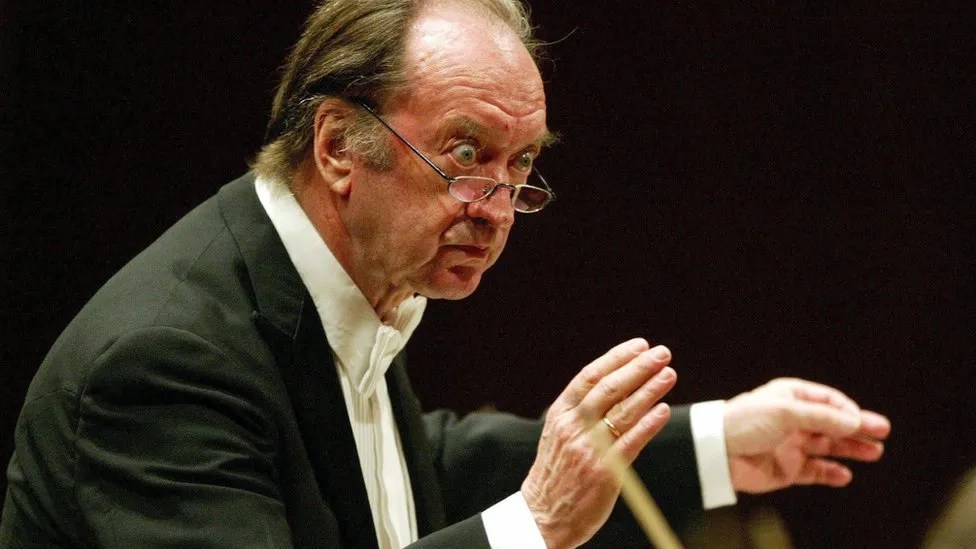
Once, working with a legendary Viennese conductor, the late Nikolaus Harnoncourt, I pointed out to him that when he gets tired he tends to slow down at the end of phrases and that the tension in the music dissipates. Many conductors would have told me to pipe down but Nikolaus respectfully heeded my impertinent observation, saying “Yes, the hammer seems to get heavier when I become tired.” He meant the up beat, the final beat in a bar before the down beat, tends to be slower than the beats before it.
One of my private passions is music played by military bands. Their purpose is to provide marching music, so the tempo has to be rock solid. I get a thrill when I hear the effect the rigid tempo has on cadence. There’s no hammer lifting and it lends the music a solemn urgency. The line of tension in the music stays taught from beginning to end.
But then there is music that comes from the inner world of thought and feeling. I used to deny even that music its natural tendency to lift and fall. Reflecting on Lynn’s words I now realise this is to deny the music and the performers playing it, the window on humanity that skilful rubato, the term musicians give to the ebb and flow, offers to the listener. A virtuoso interpreter of Chopin will trick their listener into believing they are witness to an improvisation; that the music is coming straight from the heart of the soloist. If overdone, I distance myself from the indulgence. If done well, I surrender to the music’s invitation to be transported with it.
 Toby the Tenor
Leave a comment