Part 2
After his death, a letter known as “Immortal Beloved” was discovered by Beethoven’s assistant and biographer, Anton Schindler, locked in a secret drawer. The letter, scrawled in the composer’s hand and dated 5th to 7th July, 1812, was addressed to “Unsterblicher Geliebte” or Immortal Beloved and written in four sections over three days. There is no further indication of the addressee.
The letter reads like the helter-skelter passages of his 7th Symphony, itself written at about the same time. There’s no logic or structure in his words. With sentences like “My heart overflows with a longing to tell you so many things – Oh – there are moments when I find that speech is inadequate – Be cheerful – and be forever my faithful, my only sweetheart, my all, as I am yours”, it is an outpouring of ardent longing, pure and simple.
Why didn’t he send it?
Beethoven never married but we do know he had a string of intense crushes for aristocratic Viennese women by way of close associations. In 1801, Julie “Giulietta” Guicciardi began taking piano lessons with him. He almost immediately became besotted with her despite her marriage to a count, who also happened to be a composer. He dedicated his “Moonlight” Sonata to Guicciardi and, according to Schindler, claimed she had been a great love of his some years later.
Not long after his crush for Guicciardi petered out his eye turned to another student, Josephine Brunsvik. Again, Beethoven seems to have quickly developed a passion for his pupil and remained close to her after her marriage to a nobleman. Beethoven pursued Josephine after she was widowed several years later but she rebuffed him, mindful that she could lose her children if she were to marry a commoner.
Some time later, Josephine bore a child out of wedlock and hastily married a commoner with disastrous results. The ill-matched couple quarrelled and soon separated. We know all this because Josephine’s sister, Teréz, kept a cryptic journal in which she indicated her sister would have been better off with Beethoven.
Intriguingly, the diaries of both sisters go silent for much of the summer of 1812, when it is believed Josephine was in Prague, where Beethoven stayed for a few days en route to Teplitz, a spa town between Prague and Dresden. Nine months after Beethoven wrote his “Immortal Beloved” letter, Josephine gave birth to a daughter. There is no proof she was Beethoven’s child but the rumour lingers even today.
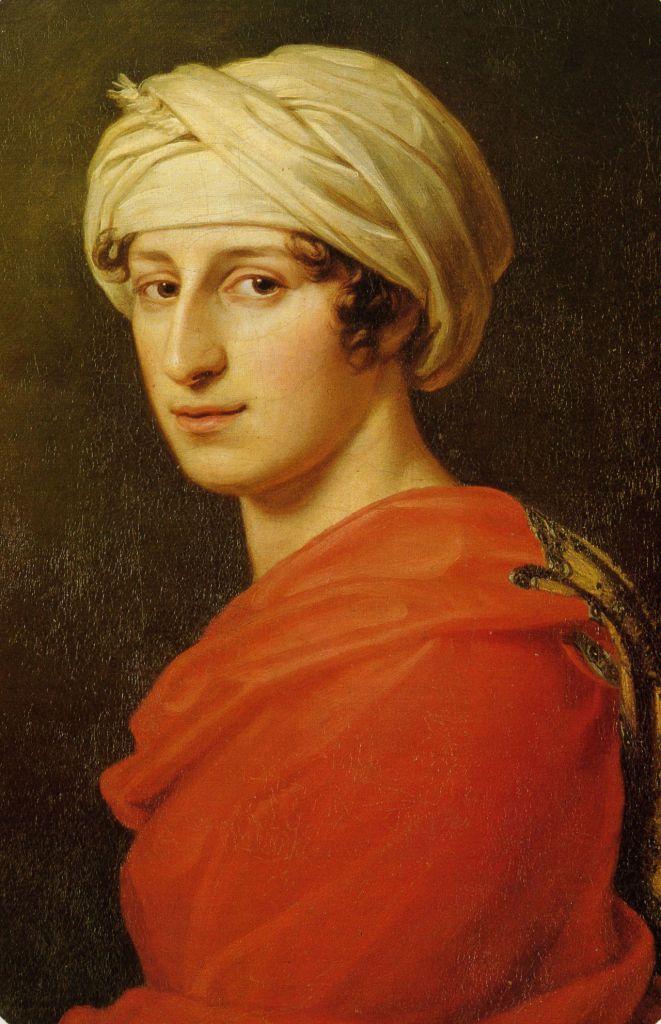
In 1810, Beethoven developed a close association with Antonie “Toni” Brentano, the daughter of an Austrian diplomat and matron of the arts. She too was in Prague in early July, 1812 as she passed through on her way to Karlsbad, the same week Beethoven wrote his unsent letter. Later in 1812 he wrote a song “An Die Geliebte” and dedicated it to Toni. A picture of her was found in the same drawer as the letter after his death.
Brentano was happily married and bearing her sixth child in the summer of 1812. She and her banker husband remained friends with Beethoven until his death.
You can draw your own conclusion as to whom the letter was intended. I’m interested in what we know about Beethoven for sure, the patterns of behaviour Beethoven displays and the effect his rebuffed advances had on his mental state.
Along with Byron, Beethoven was the celebrity of the age. We know he cut an almost comically caricature physical presence. He was dyspraxic and stumbled as he walked, depending on a cane to keep him upright. He drank heavily, was flatulent and known not to spare time for grooming or cleanliness. Famously, he was deaf and carried various contraptions around with him to help him communicate. Stravinsky claimed he played the piano bent forward with a pencil between his teeth so he could feel the vibrations of the instrument.
His tendency to fall for unavailable women fits with the image of a famous and successful artist who lacks the outward appeal of good looks or elegance. By falling for women who were above his station or already taken he didn’t have to face up to his lack of comeliness.
After writing and not sending his letter, Beethoven closed out 1812 by completing his hugely popular 7th Symphony. He then descended into a blue funk and barely wrote any music at all in 1813, tickling the manuscripts of his 8th Symphony, the Op.95 “Serioso” Quartet, and writing one song “An Die Hoffnung” (To Hope).
In 1814 he finished the quartet, the symphony, the great “Archduke” Trio and started his mawkish Op.90 E minor piano sonata. In 1815 he fell more or less silent again.
In 1816, Beethoven set A Die Ferne Geliebte. Nobody knows whether he approached Alois Jeitteles to write the poem that underpins the songs or Jeitteles had already written and published the poems. The young man Jeitteles, an interesting figure himself, had already published some poetry in Viennese periodicals. He was 21 at the time and became a friends with Beethoven through their collaboration.
My guess, and it is no more than a guess, is that Beethoven went to Jeitteles with his commission for a specific text to fit his requirements for a song he had to write and dedicate for personal reasons. My guess is that he specified the poem should be strophic and depict nature, landscape and seasons that divide two lovers and that it should be cyclical. I think this first song-cycle ever written is intended as the classification he gives it: a song circle or Liederkreis. I also think An Die Ferne Geliebte is symbolic of completion and coming full circle through the experience of love, separation, longing, heartache and finally acceptance. It’s possible that it also represents a wedding band and a betrothal.
As noted in yesterday’s blog, An Die Ferne Geliebte turned the page on Beethoven’s failure to find fulfilment in love and opened a new chapter of creativity and invention in the final fruitful decade of his life.
 Toby the Tenor
Leave a comment