Part 1
My blog today is an extension of Subsidised Vowels. First, a warning: when I write about Beethoven, I always start with the ambition to skewer him but invariably fail.
I’ve decided Beethoven is like Venice in that everyone has their own personal relationship with his music. I spent two months of last summer in Venice, working on a production at the opera house, La Fenice. During that time I had various friends come to visit and learnt very quickly that everyone likes to have their own private affair with the city. Sharing my newly acquired knowledge of the best spots required self-censorship and timing.
Beethoven is similar. It’s because Beethoven composes in the most personal terms, allowing his ruminations, his obsessions and his unbridled passions to shine through. He is deeply intimate with us and so we are with him.
I recently blew the dust off his 1816 cycle, An Die Ferne Geliebte (To The Distant Beloved). This time I delved deeper into the six songs that make up the cycle than I have done previously. I asked myself why I keep coming back to this set of songs. Why do I love them so much? Alois Jeitteles’s quaint verse on which the songs are based is not great poetry – if anything, it’s doggerel – and Beethoven’s settings are mostly strophic, relying on interludes and variation in the piano accompaniment to draw out the textual shifts in colour. The samey rhymes are difficult to memorise and if I have a slip it can lead to catastrophe.
Part of the reason I keep going back to the cycle is the challenge the cycle poses in performance, I get a kick from the jeopardy. Placing it at the beginning of a recital programme gives me a sense of relief once it’s over and I greet the songs that follow it like old friends.
But the real reason for running the gauntlet with the text and the (cata-)strophic songs is the sense of arrival as the final song begins.
The six songs are through-composed, as one uninterrupted movement with no break between them. The first five songs are written strictly in verse form as if the poet is searching for the truth behind his feelings of longing and detachment by going over the same imagery of season, landscape and nature over and over again.
Eventually, the verse melts into warmer sentiments as the poet surrenders the songs to his beloved saying “Take then these songs which I have sung for you. Sing them again in the evening to the accompaniment of the sweet lute, when the red light of evening draws down into the calm blue lake and the last rays fade behind the mountain peak. And you sing…” As I write these words the glow of Beethoven’s dusk comes to me and I am wrapped in the warm blanket of melancholy that is long distance loving.
Finally, after twelve minutes of the poet’s pathetic fallacy, Beethoven returns to the music of the first song – An Die Ferne Geliebte was the first song cycle to be conceived. The wheel of the cycle has turned fully but by giving voice to his longing the poet has changed. He raises the temperature of the human emotion and his projections onto nature fall away. Focusing his gaze in the direction of the distant beloved, he wills her to sing the songs that he also sings with a full heart and without artifice, aware only of the longing. And in doing so, he tells her the distance that separates them will be as nothing and a loving heart will be reached by what a loving heart holds sacred.
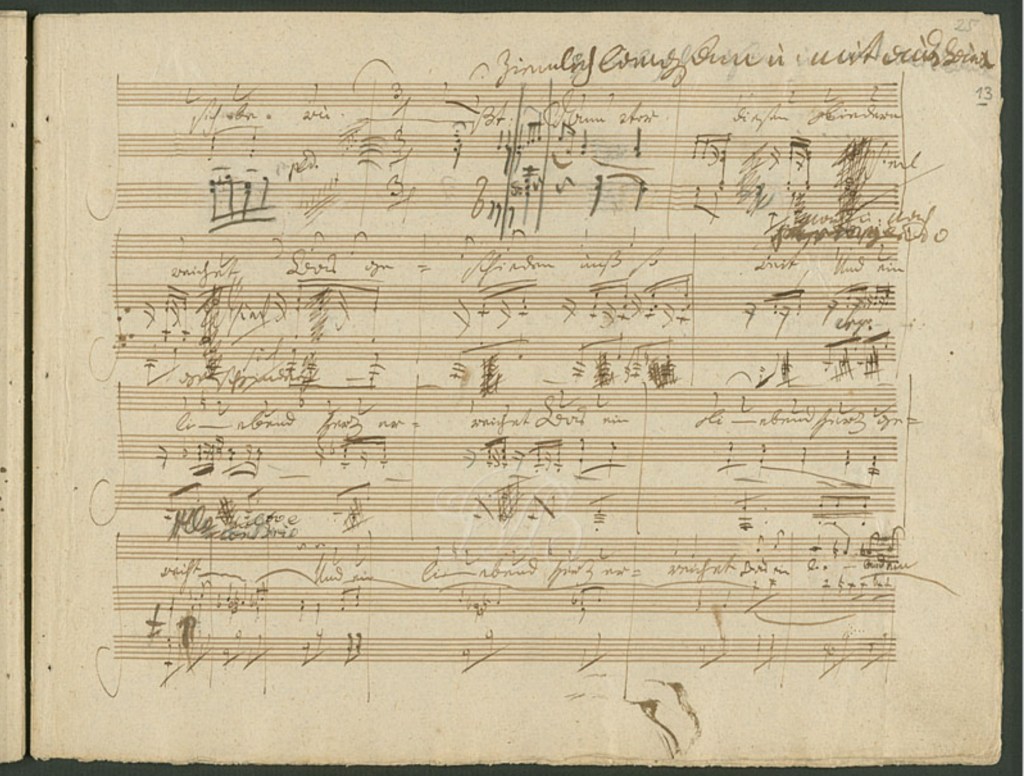
In the three years leading up to writing An Die Ferne Geliebte, Beethoven fell into a fallow period. Nothing of note came from his pen. The manuscript of An Die Ferne Geliebte reveals that it was written in a burst of energy. The lightning speed with which he wrote the songs can be seen in the strikes, jabs and slashes of his pencil. His hand moves so fast across the pages that he only manages to annotate three bars of music onto the staves of the broad sheets of paper. It is as if a build up of nuclear creative energy explodes in one short song.
Beethoven’s feverish eruption gave way to his richest decade of composition before his death in 1827. The last great piano sonatas, the Late Quartets, Missa Solemnis and the 9th Symphony burst into existence. Each one a masterpiece and worthy to be considered his greatest work. What lay behind his creative log jam and the subsequent outpouring of sublime music?
I’ll tell you in my next post.
 Toby the Tenor
Leave a comment