The best lay-out I know for an opera house is to be found at the Teatro Real in Madrid. The stalls and tiers of the auditorium are laid out in the shape of the classic horseshoe, the sight lines are good, the orchestra pit is roomy, the stage is a sizeable and well appointed with wing space, machinery and a storage dock at the back. The dressing rooms are next to the stage, rehearsal space is plentiful, there’s a good restaurant on the roof, a huge workshop where entire sets can be built six floors underground, all in the centre of the city on a plot the size of a large church. The architect who oversaw the modernisation, Francisco Rodríguez de Partearroyo, got it pretty well spot on from the point of view of both audience and performers.
I’m told Rodríguez Partearroyo approached the technical director of the Teatro Real before he started work and asked him to assist in the design of the backstage part of the theatre. What a great idea! Who knows more about what a theatre needs than the technical director, the man responsible for engineering the sets for them to be inserted and changed within the stage box?
Too many times, big theatre and concert hall projects veer off course because of cost overruns and over-ambition on the part of the architect. Hamburg’s Elbphilharmonie by Herzog & de Meuron. The foundation stone was laid in 2007 but the hall opened in 2017. After all that time, when they played the first concerts they discovered it has a tricky acoustic. Sounds seem to come and go, cancelling each other out depending on the layout of the instrumentation.
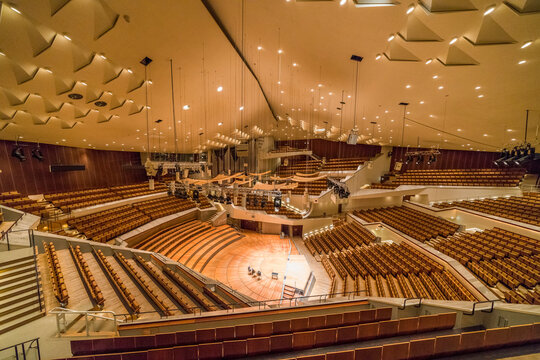
After the opening of the Philharmonie in Berlin in 1963, everyone agreed the concert hall was a huge success. The public spaces were festive and ample, placing the stage centrally within the hall and ranging vineyard-like terraces of seating around the stage made even the cheaper seats feel intimately connected to the stage, the sound is precise, generous and warm, the choices of high quality stone, concrete and wood are pleasing and the backstage spaces are bountiful. Hans Scharoun aced it and now architects try to emulate his success by terracing the audience seating around the stage in a similarly democratic pattern.
Since Scharoun devised his asymmetrical, tent-like concert hall the science of acoustic engineering has developed markedly. Yasuhisa Toyota is the acoustician to whom all architects go when they have a hall to build. It seems architects are so trustful of the acoustician’s art that they believe they can engineer better sound into the hall after it is completed. They’re wrong and the Elbphilharmonie is living proof.
I once had the privilege to meet Frank Gehry after a concert at Walt Disney Concert Hall in Los Angeles. I asked him what his models were for designing the hall. He answered “Of course the Philharmonie in Berlin but I also thought about the shape of a violin and how so much resonance can be found in what’s really just a wooden box.” I’m confident there was more to it than creating a violin shape but I like his back to basics approach and his regard for the luthier’s craft as well as scientific method.
Aside from the comfort, sound and intimacy of the hall itself, I look for the way a hall reflects the best of the age in which it is built. The earliest halls have distinct and separate facilities for audience and performers. The priorities are clearly expressed in the luxurious audience areas with galleries and bars, sweeping stair cases. The auditoria of the first halls all had flat floors and a shoebox shape because they doubled as ballrooms. The back stage area of one such hall, the Musikverein in Vienna, is pokey to the point that one is constantly stopping in the narrow corridors to allow a player with a priceless instrument to pass without knocking it. Dressing rooms are afterthoughts, rehearsal rooms for preparatory work are airless, unwelcoming spaces that double as storage.
There was a time at the crossover of societal change brought on by the revolutions of the late C18th when musicians worked in both royal household orchestras and civic orchestras. Musicians were employed as servants and navigated through the servants entrance and passages of the household, not to be seen until their music was required. When the first purpose-built concert hall was opened in Leipzig in 1781, the musicians had their own entrance separate from the audience and drapers guild (hence Gewandhaus) members who had paid for the new hall. Naturally, the stage and auditorium are at opposite ends of the hall and so having a separate entrance negates the need for a passageway to the other end of the building but having separate entrances creates complications and missed opportunities.
As a performer, I like to talk to friends and family over a drink after a performance. Most halls these days have the auditorium suspended above ground level. The ground level is a collecting space in which to cast off coats and get a drink. Why don’t we all enter and leave through the same doors? It would offer the opportunity to talk about the concert and for performers to answer questions about the work. What if, at the end of a concert, the bars were licensed to 11pm for audience members to remain behind, if they choose, to have an open forum in which to discuss the music with the professionals? You might ask what if the performers don’t want to. It could be a good investment to incentivise the performers with a free first drink.
At the Philharmonien in Bergen, Norway, the orchestra has a performance space in the large bar area where orchestra members are encouraged to play their less formal musical projects for lingering audience members after their concerts.
Were I to commission a concert hall, the one thing that I would prioritise is that there be no separate artist entrance. I would have a pass door once inside the hall through which performers enter the backstage area but the enclosed collecting area for audience and musicians would be the same space at the beginning and end of the evening.
 Toby the Tenor
Leave a comment